
Marc von Ah
Dog trainer and coach.
I observe before I claim anything.
How it all started
My first memory of working with dogs: I’m eight or nine years old, running through the neighbourhood in my socks in pouring rain, chasing after our Airedale Terrier, Raja. Raja was an escape artist — it sometimes felt like she could get through closed doors. Though with three kids in the house, that was rarely necessary. Something was always left open somewhere.
I didn’t catch her because I was faster in my socks. I caught her with a spontaneous, clear command.
That was my first lesson, and it still holds true today: dogs don’t react to what we say, but to how we mean it.
Coach first, dog trainer later — and why that’s not a disadvantage
I make no secret of it: I come from the human side.
I’ve worked with people for decades — as a journalist, in corporate communications, and most recently as a coach and trainer. Seven years of coaching and training, over 1,500 hours of courses and coaching, more than 500 people.
Dogs were always part of my life, in my family and my circle of friends. It became a profession later: once I had two Labradors of my own, I trained as a dog trainer at the Wolfsrudel Academy and worked there with real clients for the first time.
What I learned there wasn’t what I expected.
I’d thought I’d mainly need knowledge about dogs. Instead, I kept seeing dog owners who knew exactly what to do — and just didn’t do it in the crucial moment. Not out of ignorance. But because they reacted two seconds too late, because the leash wasn’t positioned the way they’d planned, because the decision was only made once things had already started.
That’s exactly where my strength lies. I see these things because I’ve spent years practicing how to watch people in action.
And honestly: if you’re looking for someone with 25 years of experience with dogs, you’ll find a few in Canton Zug. What’s harder to find is someone who can explain to you what you’re doing in the situation — and how to change it.
How a session with me works
Listening
For the first 15 to 20 minutes, you do most of the talking. What's happening, since when, in which situations? And above all: what have you already tried, and what did it do? That saves us both from repeating things that don't work for you.
Observing without judging
Then we go outside — or stay inside, depending on where it happens. I say as little as possible and watch as much as possible. Not just your dog. Also your timing, how you handle the leash, your movements.
Questions instead of instructions
I ask "What just happened there?" more often than I say "Do it like this." Not out of stubbornness, but because you should be able to read the situation without me afterward.
Video, when it helps
Some things you only see on replay. When it makes sense, we film an encounter and watch it together. Often, that's the moment something clicks — for you and for me.
Reporting back what I saw
At the end, I tell you what I observed. In describable terms: what happened when, in what order, at what distance. Not interpretations. Where I'm unsure, I say that too. "This could be X or Y — let's look at that specifically next time."
The plan
After that, you get it in writing: exactly what, how, and why. And what to watch for next time, so we both learn more.
What I can do — and what I can't
What I can do
✅ Coaching for people — 7 years, over 1,500 hours of courses and coaching, more than 500 people. Trained at the Coaching Institut Living Sense, plus an SVEB qualification in adult education.
✅ Dog training — certified by the Wolfsrudel Academy, plus ongoing further training. Focus: everyday issues, especially on-leash dog encounters.
✅ Observation — that’s my actual craft. I notice things that get lost in the moment: timing, sequence, distances.
✅ Systemic thinking — I look at the person, the dog, and the environment together, not any one element in isolation.
✅ Practice — since 2023, with two Labradors of my own, Sabooh and Kylie. Two dogs of the same breed who couldn’t be more different.
What I can’t — and won’t — do
❌ Behaviour therapy — for serious aggression, biting incidents, or severe anxiety, I recommend specialists.
❌ Assess your dog online — for that, I need to see him live.
❌ Miracles — change takes time, and your cooperation.
❌ Standard programs — every team is different.
❌ Tell you what’s wrong before I’ve taken a look — even if you ask me to.
When I'm not thinking about other people's dogs
Sabooh
Male Labrador, born 2024. My most important teacher. He reminds me every day that theory and practice are two different things.Kylie
Female Labrador, born 2023. Our first dog, mainly handled by my wife. Kylie keeps showing me just how different two dogs of the same breed can be.And beyond that:
A lot of time in nature: exploring forests, cooking over an open fire, watching wildlife and plants. Indoors, I read a lot — psychology, stoic philosophy, dogs, sometimes novels too.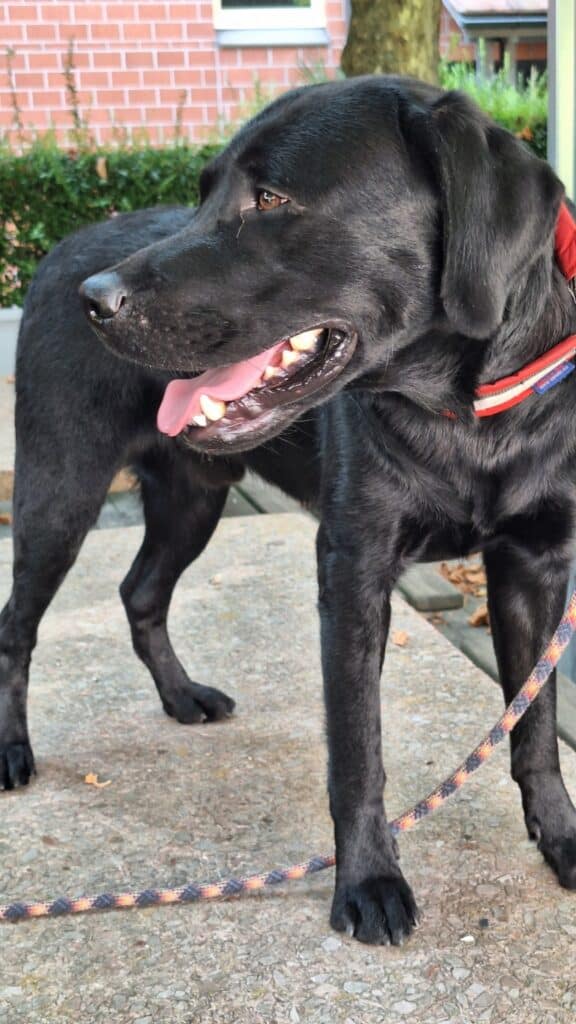
Why "Dialog.Hund"
Dialog stands for two-way communication. Not for instructions that only go one way.
Hund stands for the concrete, practical level. For what’s actually right in front of you, and doesn’t wait around for the theory to catch up.
Together: a conversation between the two of you, with me as the translator.
Let's talk
A website can only give you a first impression. Whether it’s the right fit is something we’ll both find out in conversation.
30 minutes, free, on Zoom. You tell me about your situation, and I’ll tell you honestly whether I’m the right fit.